Quick answer
Builders flagged things we needed to hear: cost data fields that need populating, a formulation endpoint they want sooner, documentation with worked examples. Every note is now on the roadmap.
We opened the Journey Foods API to Atlanta builders for the first time and asked one question: what do you build when the data layer is actually open?
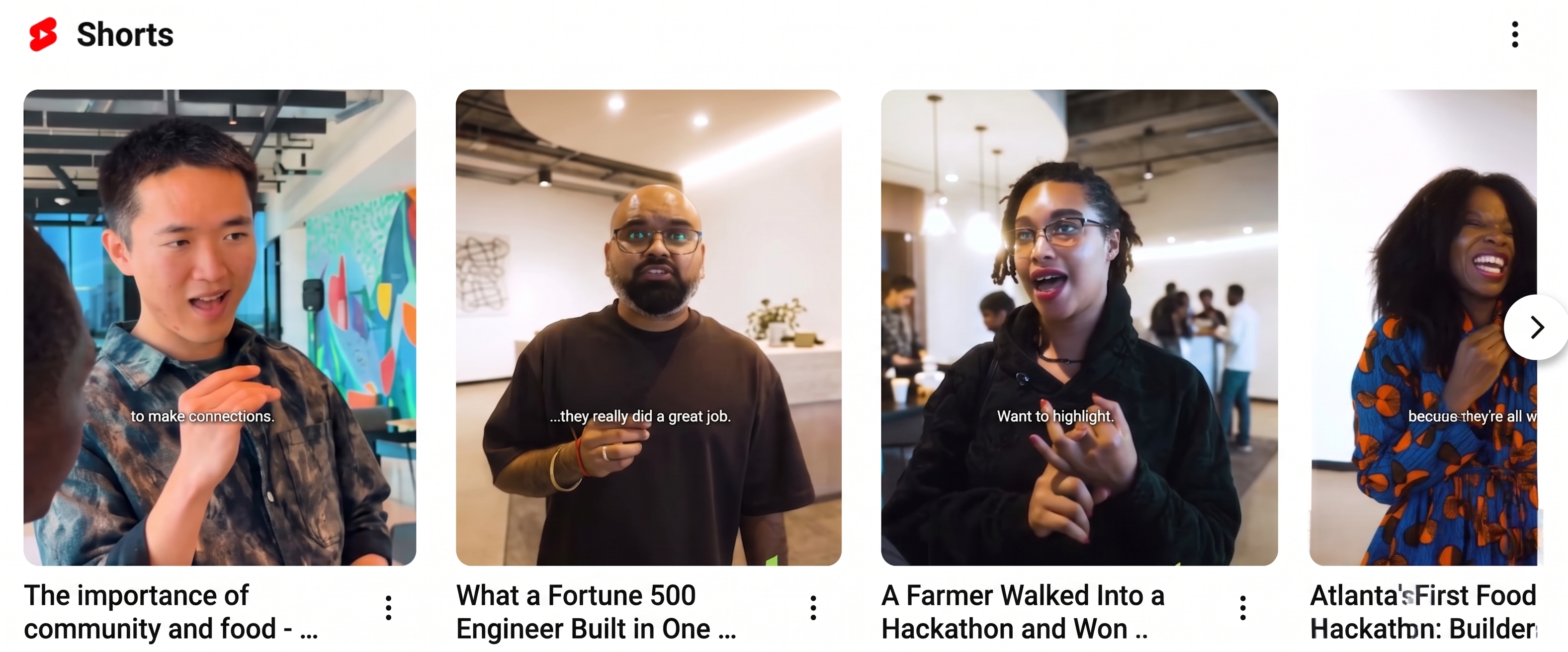
Fifteen teams showed up. One afternoon. Every project shipped on the Journey Foods API.
Solo developers. Four-person Georgia Tech teams. A middle schooler. Atlanta showed up.
The Signal in the Room
We gave builders nine problems to choose from. Five of them picked the same one — without coordinating. Small food businesses are flying blind on margin.
That kind of convergence is the loudest market signal you can get. Fortune 500 food brands have entire teams for commodity forecasting, substitution modeling, and SKU sensitivity analysis. The bodega owner, the food truck operator, the neighborhood restaurant — none of them have that. And the margins are thinner, so the consequences hit harder. Five teams built five different attacks on the same gap:
- Sage — supply chain intelligence layering news, weather, and commodity markets on top of Journey Foods ingredient data, built by a four-person Georgia Tech team
- Margin CFO — ingredient-to-margin intelligence for emerging F&B founders
- BistroAI — allergen risk flagging and supply chain cost forecasting for food trucks and ghost kitchens
- MarginBites — per-dish risk scoring with one action per item: swap, reprice, or hold
- MORTAR — inventory and pricing intelligence for corner stores, cafés, and neighborhood grocers
Food Access at the Neighborhood Level
A solo developer named Palak Kakani built FreshPath ATL in one afternoon. Enter your neighborhood, household size, weekly budget, and SNAP/WIC status — and get a week of meals you can actually afford, an itemized grocery list, and a map of the closest SNAP-friendly stores.
14 Atlanta neighborhoods mapped at the block level. Every price pulled from the Journey Foods API. None of them invented.
This is the kind of tool a city nutrition office would spend a year procuring through RFPs and six-figure vendor contracts. A local developer built a working version in an afternoon on shared infrastructure. That is the difference.
Keeping Grandma at the Sunday Table
The hardest food systems problem is not nutrition science. It is culture. A team built Sunday Plate to work that problem from the other direction — three ingredient swaps sourced from NHLBI's African American heart-healthy cookbook that keep the recipe recognizably itself. The collard greens are still collard greens. The cornbread is still cornbread.
Same Sunday dinner. Three generations at one table. This is what nutrition infrastructure makes possible when it is built right: not replacement, but precision.
Another team — HealthyClaw — built a live chronic care agent that adapts to T2D, CKD, hypertension, and pregnancy. Two people. One afternoon. Four chained endpoints. 40 API hits per query.
What the Judges Heard
Judges Akshita Iyer, Tope Mitchell, Ph.D., and Eddie Lai gave teams feedback they couldn't have gotten anywhere else. Atlanta food problems don't get solved in slide decks — they get solved by builders who know the city.
Other projects that caught attention:
- JourneyResilience — real-time supply chain reformulation
- Menu Lab — GLP-1-friendly menu rewrites for restaurants
- AI-powered ingredient label decoding and allergen compliance tools for ghost kitchens
What Comes Next
Builders flagged things we needed to hear: cost data fields that need populating, a formulation endpoint they want sooner, documentation with worked examples. Every note is now on the roadmap.
The same data layer is open to a developer in Detroit, Houston, Birmingham, or Oakland. Most of them haven't heard of us yet. That's the next phase.
"Cities have food systems problems they cannot solve alone. The Journey Foods API gives government the infrastructure to bring local technical talent in to solve them. Atlanta just proved the model."
— Riana Lynn, Founder & CEO, Journey Foods
If you're a developer → The portal is open.
If you're a city official → The model is proven.
If you're a food operator → The tools are coming faster than they have in a long time.
Data from this story
Shareable Journey Intelligence
Atlanta's First Food A.I. Hackathon: What Happened When We Opened the API
News & Events