CNBC Feature: AI startups want to crack open the recipe book in Big Food’s test kitchens


Quick answer
Across 23 countries, through partnerships with academic institutions through Journey Labs, serving enterprise customers who manage billions in ingredient spend—Journey AI is building the operations intelligence platform the CPG industry actually needs.
Beyond Recipe Testing: How Supply Chain Intelligence Is Actually Transforming Food Innovation
A response to recent media coverage and what's really happening in CPG tech
The Misunderstood Revolution
Last week, CNBC published an article titled "AI startups want to crack open the recipe book in Big Food's test kitchens," positioning Journey Foods alongside companies developing "virtual sensory" systems and AI-powered recipe testers. While we appreciate the coverage, it misses the fundamental challenge that's actually keeping CPG executives up at night.
Big Food doesn't need AI to predict if chocolate chip cookies taste good - we love a human feedback loop. They need AI to navigate the chaos of modern supply chains with flavor and texture as guardrails. It's like wrapping an ethics layer on legal or therapy AI. It is more than necessary.
The real question isn't "Will consumers like this flavor?" It's "Can we source these ingredients reliably at a price point that works when our supplier in Southeast Asia faces climate disruption, when trade policies shift overnight, and when consumer demands for sustainability credentials evolve faster than our reformulation cycles?"
That's the problem Journey AI—and our flagship subsidiary Journey Foods—actually solves.
The Real Crisis in CPG Innovation Isn't Taste—It's Data
Here's what a typical product development cycle looks like at a major CPG company today:
- R&D teams work in spreadsheets with outdated ingredient costs
- Procurement discovers supply issues after formulations are locked
- Sustainability teams calculate carbon footprints manually, weeks after decisions are made
- Regulatory catches compliance issues in final review, forcing expensive reformulations
- Operations learns about ingredient availability problems when it's too late to pivot
The result? Products that take 18-24 months to launch, with failure rates above 70%, and supply chain surprises that evaporate margins overnight.
This isn't a recipe problem. This is an operations intelligence problem that spans the entire human consumption supply chain—from food and beverage to personal care, supplements, and beyond.
What Supply Chain Intelligence Actually Means
When we say Journey AI provides "supply chain intelligence," we're talking about a fundamentally different approach to CPG innovation. Our platform processes over 60 billion data points from 22,000+ sources to give product teams real-time answers to questions like:
- What happens to my cost structure if palm oil prices spike 40% next quarter?
- Which alternative sweeteners meet our nutrition targets, sustainability goals, AND have stable supply in our target markets?
- How does reformulating with pea protein instead of whey impact our carbon footprint, allergen profile, AND supplier risk simultaneously?
- What compliance changes are coming in the EU that will affect our current formulations?
We've built what we call an Operations Scientist™—an AI system with 1,368 base tags that expand to over 5,000 combinatorial features across nutrition, cost, sustainability, regulatory compliance, and supply chain stability.
This isn't about predicting sensory outcomes. It's about giving enterprises the intelligence infrastructure to make better decisions, faster, with complete visibility into the trade-offs across their entire product portfolio.
Case Study: When Supply Chain Intelligence Prevented a Crisis
Let me show you what this looks like in practice.
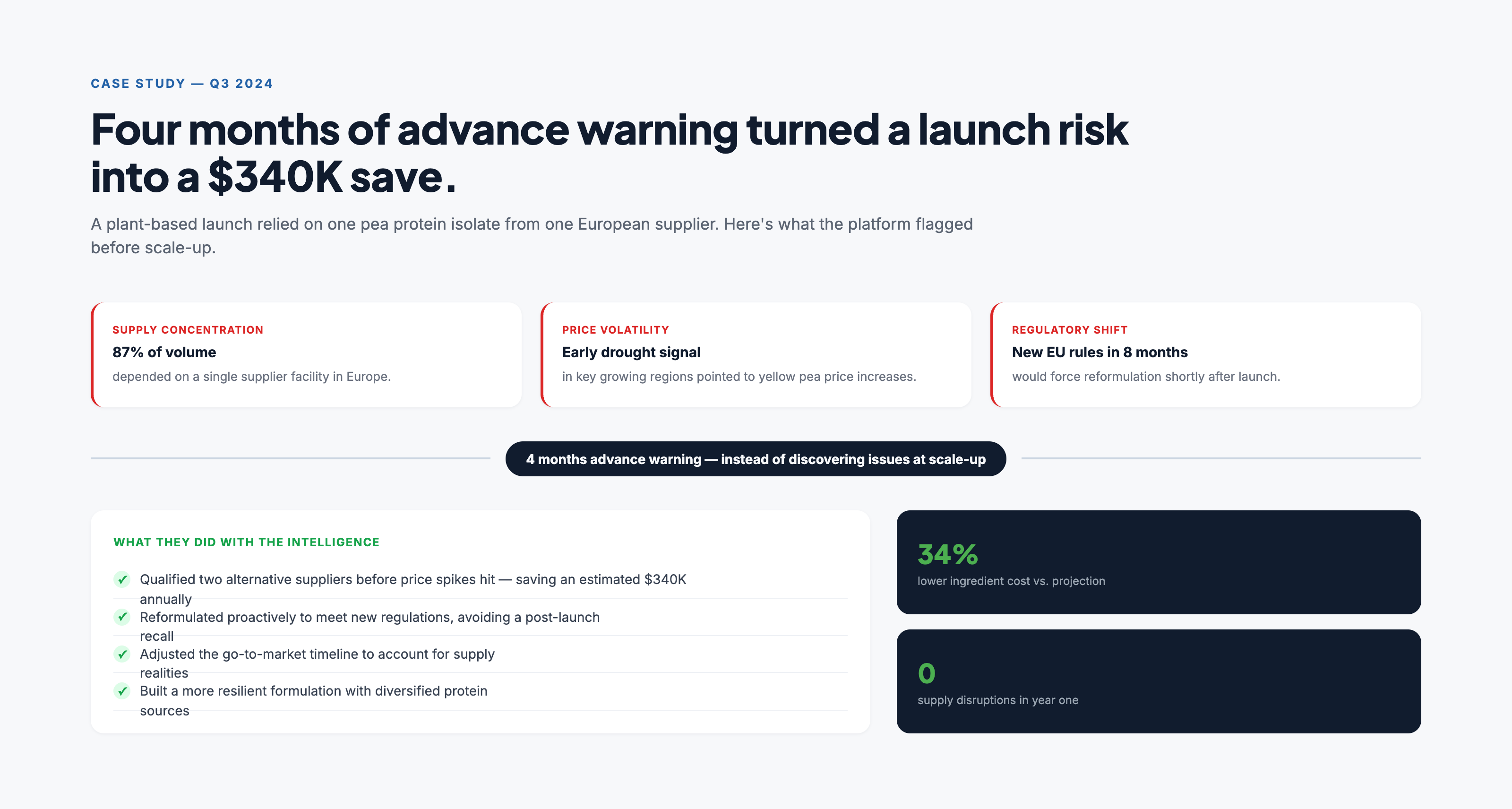
A major food manufacturer came to us in Q3 2024 planning to launch a plant-based product line in early 2025. Their formulation relied heavily on a specific pea protein isolate from a primary supplier in Europe.
Our platform flagged three critical issues their internal teams hadn't caught:

Journey Ingredient Intelligence
Pea Protein
How does reformulating with pea protein instead of whey impact our carbon footprint, allergen profile, AND supplier risk simultaneously?
A South American tree in the family Lecythidaceae.
Nutrition. Pea Protein has a nutrition profile including 1602 kcal/lb calories, 354.26 g/lb protein, 14.06 g/lb fiber, and 0.00 g/lb total sugars.
Cost. Pea Protein is currently priced at $29.74/kg.
Sustainability. Journey AI evaluates ingredient sustainability using environmental indicators such as water usage, greenhouse gas emissions, and upcycled status.
- Supply Concentration Risk: 87% of their planned volume depended on a single supplier facility
- Price Volatility Signal: Our commodity tracking showed early indicators of yellow pea price increases due to drought conditions in key growing regions
- Regulatory Shift: Upcoming EU labeling requirements would require reformulation within 8 months of launch
Instead of discovering these issues during scale-up (the usual pattern), they had 4 months advance warning.
Here's what they did with that intelligence:
- Qualified two alternative suppliers before price spikes hit (saving an estimated $340K annually)
- Reformulated proactively to meet new regulations, avoiding a post-launch recall
- Adjusted their go-to-market timeline to account for supply realities
- Built a more resilient formulation with diversified protein sources
The result? A successful launch with 34% lower ingredient costs than originally projected, zero supply disruptions in the first year, and a product positioned for long-term stability.
That's not recipe testing. That's operations intelligence.
From Journey Foods to Journey AI: Expanding the Mission
What started as Journey Foods—solving supply chain intelligence for the food industry—has evolved into Journey AI, a comprehensive platform for human consumption supply chains.
Why the evolution? Because the fundamental challenges we solved in food exist across every category of consumer packaged goods:
- Personal care companies struggling with ingredient sourcing, sustainability claims, and regulatory complexity
- Supplement manufacturers navigating supply chain volatility and quality verification
- Beverage companies managing formulation optimization across nutrition, cost, and consumer trends
- Beauty brands balancing clean ingredient demands with supply realities
Journey Foods remains our flagship subsidiary, focused on food and beverage innovation. But Journey AI's platform now serves the broader human consumption supply chain ecosystem—anywhere ingredients meet consumer products.
The Enterprise Reality: Data Infrastructure Beats Recipe Algorithms
The media loves the narrative of AI "creating new recipes" because it's tangible and consumer-facing. But enterprise CPG companies already have talented R&D teams, sensory scientists, and decades of institutional knowledge about what tastes good.
What they don't have is:
- Real-time visibility into 9,200+ ingredient suppliers globally
- Integrated intelligence that connects nutrition data, sustainability metrics, cost fluctuations, and compliance requirements in one system
- Predictive capabilities that identify supply chain risks before they become crises
- Scalable data infrastructure that makes insight accessible across R&D, procurement, sustainability, and operations teams
- Cross-category intelligence that applies learnings from food to personal care, supplements to beauty
This is why our customers include major CPG manufacturers and we've established partnerships with retailers like Kroger and Whole Foods. They're not coming to us for better recipes. They're coming for better data.
Pilot Results: The Numbers Tell the Story
Our pilot programs in Georgia, North Carolina, Hong Kong, and Ghanag with food manufacturers have demonstrated:
- 34-41% reduction in food waste through better ingredient optimization
- Average 23% faster formulation cycles with integrated supply chain data
- ROI positive within 6 months for mid-size manufacturers
These aren't incremental improvements from slightly better recipes. These are structural efficiencies from having the right intelligence at the right time.
And these results translate across categories—the same supply chain intelligence that optimizes a food formulation also optimizes a shampoo formulation or a vitamin supplement.

Journey Ingredient Intelligence
Chocolate Chips
Big Food doesn't need AI to predict if chocolate chip cookies taste good - we love a human feedback loop.
A South American tree in the family Lecythidaceae.
Nutrition. Chocolate Chips has a nutrition profile based on the current Journey Foods nutrition table: Calories: 2177 kcal/lb, Protein: 19.05 g/lb, Fiber: 26.76 g/lb, Total Sugar…
Cost. Chocolate Chips is currently priced at $11.30/kg.
Sustainability. Chocolate Chips: Journey AI evaluates ingredient sustainability using environmental indicators such as water usage, greenhouse gas emissions, and upcycled status.
The Future of CPG Innovation Is Operations, Not Just Creation
As the industry faces unprecedented pressures—climate volatility, regulatory complexity, sustainability mandates, supply chain fragility—the competitive advantage won't come from who has the best recipe algorithm.
It will come from who has the best operations intelligence.
The future of CPG innovation looks like:
- Proactive rather than reactive product development, with supply chain reality built into the earliest formulation decisions
- Integrated sustainability where carbon footprint, water usage, and biodiversity impact are as accessible as nutritional data
- Resilient by design products that can flex with supply disruptions without compromising quality or margins
- Compliance-forward development where regulatory changes trigger automatic reformulation recommendations
- Cross-category intelligence where insights from food innovation inform beauty product development
This requires treating CPG innovation as a data infrastructure challenge, not just a creative exercise.
Why This Matters Now
We recently closed $5.3M in funding at a valuation over $38M because investors understand what the media sometimes misses: the future of the $3 trillion packaged goods industry isn't about AI recipe generators.
It's about giving enterprises the intelligence infrastructure to compete in an era of unprecedented complexity across all human consumption supply chains.
When CNBC or other outlets position us as "virtual sensory" companies, they're seeing the surface-level application and missing the fundamental transformation happening underneath. Recipe optimization might be one output of our platform, but the real value is in the operational intelligence that makes every decision better—from sourcing to formulation to scale-up to market, across food, personal care, supplements, and beyond.
The Bottom Line
Big Food doesn't need AI to know cookies should taste good. Personal care brands don't need AI to know shampoo should lather well.
They need AI to navigate:
- Volatile commodity markets
- Consumer demands for transparency in health
- Climate-disrupted supply chains
- Evolving sustainability requirements
- Complex regulatory landscapes
- Cross-category supply chain opportunities
Across 23 countries, through partnerships with academic institutions through Journey Labs, serving enterprise customers who manage billions in ingredient spend—Journey AI is building the operations intelligence platform the CPG industry actually needs.
Better recipes through Better decisions.

Journey Ingredient Intelligence
Palm Oil
Our platform processes over 60 billion data points from 22,000+ sources to give product teams real-time answers to questions like: What happens to my cost structure if…
A South American tree in the family Lecythidaceae.
Nutrition. Palm Oil has a nutrition profile based on the current Journey Foods nutrition table: Calories: 3888 kcal/lb, Protein: 0.00 g/lb, Fiber: 0.00 g/lb, Total Sugars: 0.00 g…
Cost. Palm Oil is currently priced at $12.43/kg.
Sustainability. Palm Oil: Journey AI evaluates ingredient sustainability using environmental indicators such as water usage, greenhouse gas emissions, and upcycled status.
As published
70%
Supplier highlight
Roquette America
Lists Pea protein isolate on the market graph.
View Roquette America dataJourney Ingredient Intelligence · Comparison
Pea Protein
Chocolate Chips
Data from this story
Shareable Journey Intelligence
CNBC Feature: AI startups want to crack open the recipe book in Big Food’s test kitchens
News & Events
70%
Products that take 18-24 months to launch, with failure rates above 70%, and supply chain surprises that evaporate margins overnight.
40%
Our platform processes over 60 billion data points from 22,000+ sources to give product teams real-time answers to questions like: What happens to my cost structure if palm oil prices spike 40% next quarter?