Quick answer
2024 taught us that price-led growth was a sugar rush. 2025 is forcing the industry to remember how to actually sell more units—while navigating private label dominance, GLP-1 appetite shifts, freight roulette, and commodities that won't behave.
As we step into 2026, the food industry is standing on a fault line.
After half a decade of disruption, from pandemic shockwaves to supply chain rewiring to the rapid acceleration of AI, the question is no longer what’s changing. It’s who adapted fast enough.
At Journey Foods, we spent the past year processing 60+ billion ingredient, formulation, and supply chain data points through JourneyAI, working alongside 1,200+ ingredient suppliers, manufacturers, and food brands across global markets. From that vantage point, the patterns are no longer subtle.
This report captures the signals we’re tracking, not predictions, not hype, but early indicators of transformation already underway. Whether you’re navigating ingredient volatility, optimizing manufacturing operations, or building the next generation of food products, understanding these shifts is no longer optional. It’s table stakes.
The future of food isn’t coming.
It’s already operational.
Let’s break down what that means.
— Riana Lynn
Founder & CEO, Journey Foods
The Big Five: 2025’s Defining CPG Signals
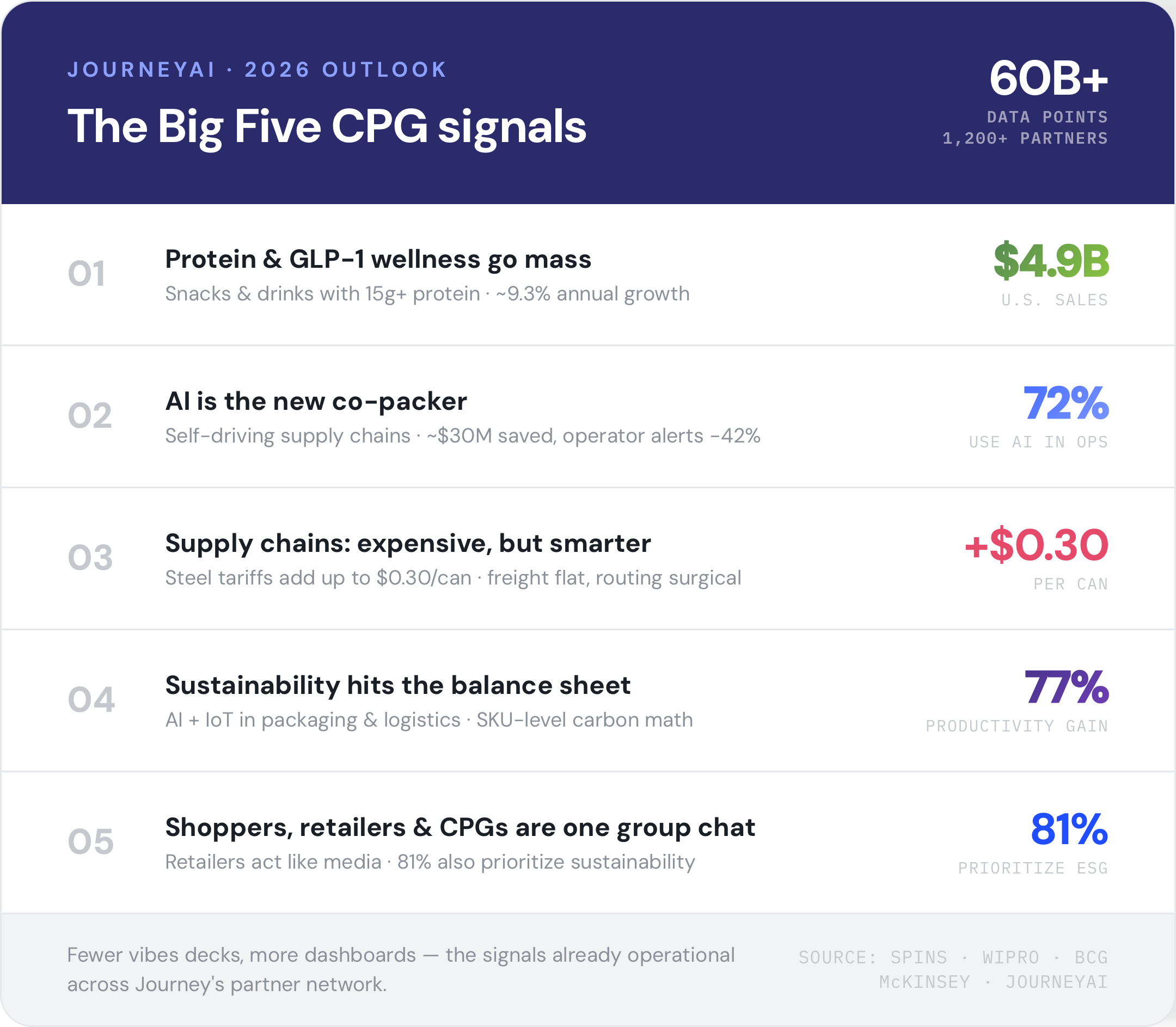
The most important food and supply chain signals of 2025 are clear:
- Protein and GLP-1–adjacent wellness are going mass
- AI is quietly running “self-driving” supply chains
- Sustainability has moved from marketing to math
- Retailers are weaponizing data like media companies
Think fewer vibes decks.
More dashboards.
Less “better-for-you” storytelling.
More SKU-by-SKU margin surgery.
Signal 1: Protein, GLP-1, and the New Wellness Basket
Consumers are no longer casually “health-curious.” They’re shopping like they have a lab in their pocket and a GLP-1 prescription in their nightstand.
Younger shoppers and GLP-1 users are trading ultra-processed staples for functional, protein-dense, portion-aware products, steadily eroding share for legacy center-store brands.
- Snacks and beverages with 15g+ of protein already represent ~$4.9B in U.S. sales, growing at roughly 9.3% annually
(SPINS) - Brands like Olipop show where demand is heading. Prebiotic sodas tied to gut health have reported ~340% year-over-year revenue growth and a 68% repeat rate within 90 days, proving that function plus flavor beats “diet” branding every time.
What this means:
Protein is no longer a niche. It’s infrastructure.
Signal 2: AI Is the New Co-packer
Behind the scenes, AI has become the operations leader CPG companies can finally afford to listen to.
Enterprise platforms are enabling self-driving supply chains, reducing noise, smoothing forecasts, and quietly reclaiming millions in wasted cost.
- One global CPG reported that AI-driven forecasting reduced operator alerts by 42% and delivered ~$30M in cost savings, exposing just how much inefficiency lived in spreadsheets and gut instinct
(Thoughtworks) - 72% of CPG and retail leaders now report integrating AI into supply chain operations, while 81% are simultaneously prioritizing sustainability, turning AI from a buzzword into the backbone of resilience and ESG reporting
(Wipro)
What this means:
AI isn’t replacing people. It’s replacing guesswork.
Signal 3: Supply Chains Are Still Expensive, Just Smarter
2025 didn’t give food supply chains a break. It gave them better analytics and worse geopolitics.
Inflation, energy volatility, tariffs, and climate shocks continue to push up transportation, packaging, and ingredient costs, forcing procurement teams into near-constant triage.
- The recent doubling of certain U.S. tariffs on imported steel is projected to add up to $0.30 per can for some products, a tiny unit cost with massive downstream impact at scale
(Lacerta) - While truckload freight rates are roughly flat year-over-year, brands are aggressively using route optimization, load consolidation, and intermodal strategies to protect margins as trade tensions and shipping disruptions persist
(Intrepid Investment Bankers)
What this means:
Cost pressure didn’t disappear. It got more surgical.
Signal 4: Sustainability Moves From Brand Story to Balance Sheet
In 2025, sustainability exited the brand team’s mood board and entered the CFO’s spreadsheet.
Regulations, tariffs, and retailer scorecards are forcing CPGs to quantify carbon, recyclability, and waste reduction at the SKU and lane level.
- Advanced automation, AI, and IoT in packaging and logistics are enabling productivity gains of up to 77%, reducing labor intensity, errors, and material waste
(Innova Market Insights / Industry studies) - Brands are using AI to redesign products and packaging with less material, higher recyclability, and lower manufacturing emissions, aligning compliance, cost savings, and brand equity in a single modeling loop.
What this means:
“Green” now has a unit cost, a margin impact, and a reporting requirement.
Signal 5: Consumers, Retailers, and CPGs Are Now a Group Chat
The 2025 consumer is value-obsessed, wellness-driven, and expects brands to be both transparent and entertaining. Meanwhile, retailers increasingly behave like media platforms, not aisles.
Winning CPGs are wiring together consumer data, supply visibility, and rapid product development to keep pace.
- Clean-label, high-protein, and functional products continue reshaping core categories as incumbents invest in science-backed nutrition, even while private label and challengers chip away at processing-heavy SKUs
(BCG) - Natural and wellness-oriented segments are forecast to continue outpacing conventional CPG growth, as aging consumers and younger shoppers converge on healthy aging, gut health, and performance as everyday needs
(McKinsey)
What this means:
The shelf is no longer static. It’s responsive.
What Comes Next
These signals aren’t abstract forecasts. They’re the reality our partners are navigating daily, from AI-driven formulation optimization to supply chain transparency demands, from waste reduction mandates to emerging ingredient ecosystems.
The companies that will win in 2026 and beyond aren’t waiting for perfect information. They’re building adaptive systems, leveraging intelligent data, and making decisive moves now.
At Journey Foods, we believe technology, when applied thoughtfully, can create a more efficient, sustainable, and equitable food system. That’s why we built JourneyAI: to turn complexity into clarity, data into decisions, and disruption into advantage.
If you’re ready to explore how ingredient and supply chain intelligence can transform your business, let’s talk.
👉 Connect with us on LinkedIn
📩 Questions or partnerships: hello@journeyfoods.com
Here’s to a year of bolder moves, smarter systems, and better food for all.

Journey Ingredient Intelligence
Heavy Cream
Clean-label, high-protein, and functional products continue reshaping core categories as incumbents invest in science-backed nutrition, even while private label and ch…
A South American tree in the family Lecythidaceae.
Nutrition. Heavy Cream has a nutrition profile of 1,527 kcal/lb, 12.70 g protein/lb, and 13.15 g total sugars/lb.
Cost. Heavy Cream is currently priced at $8.75/kg.
Sustainability. Journey AI evaluates ingredient sustainability using environmental indicators such as water usage, greenhouse gas emissions, and upcycled status.
As published
$4.9
Data from this story